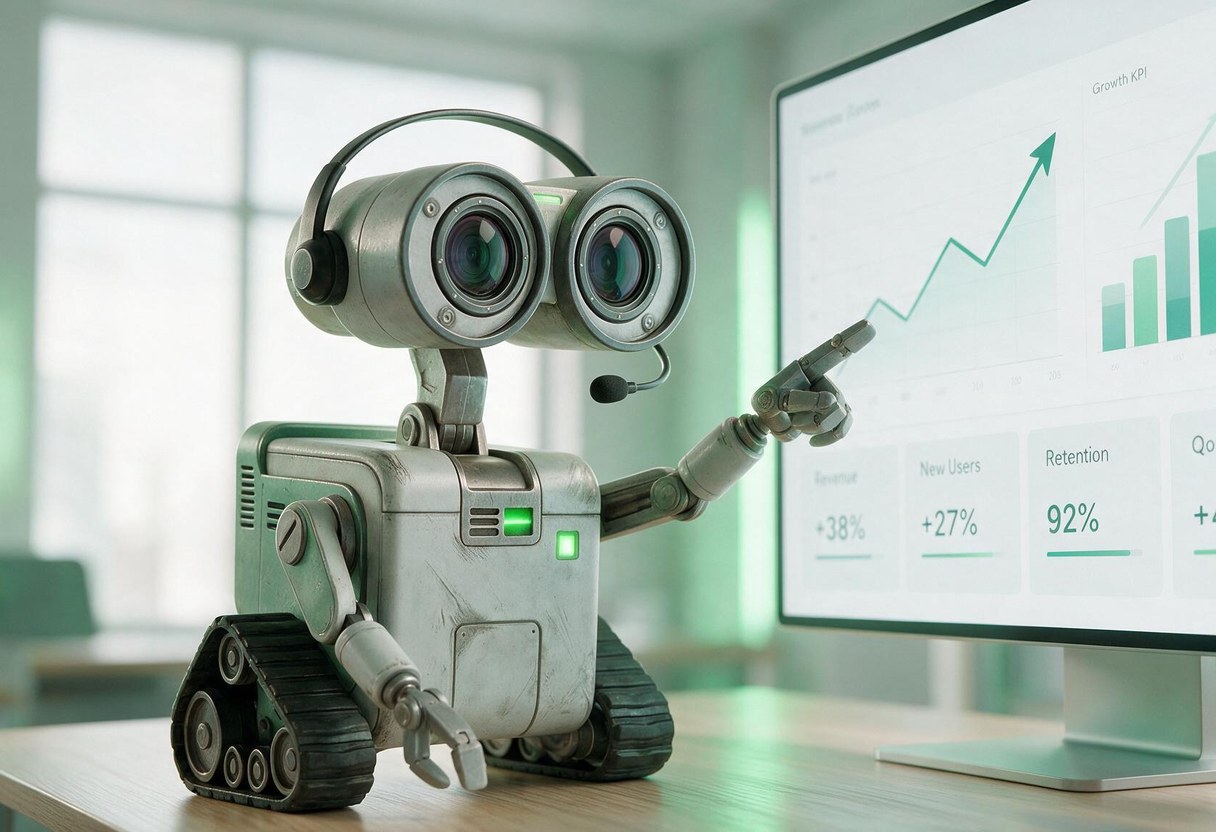
Singapore is the most AI-mature market in the world right now. That isn't hype — it's survey data. Notion's 2026 AI Transformation study polled 521 Singapore organisations and found that 21% are already running AI as teammates or as core business systems — nearly double the global average of 12.4%.
But there's another side to that statistic: 79% of Singapore organisations are still at Level 1 or 2. For them, AI is a drafting tool, a brainstorming partner, a smarter search box. Useful, but personal. The transformation everyone talks about — AI wired into how the business actually runs — hasn't happened.
If that describes your company, the data says you're not behind. You're normal. But the gap between where you are and where the value is has a shape, and it's worth understanding.
The Four Levels, Briefly
Notion's model maps AI adoption into four levels. Level 1 is AI as a thought partner — individuals using standalone tools to draft, brainstorm, and analyse. Level 2 is AI as an assistant — embedded in daily work, with some access to company context. Level 3 is AI as teammates — agents running recurring workflows end-to-end, with humans reviewing at defined checkpoints. Level 4 is AI as the system — autonomous agents running business-critical processes.
The important shape in the Singapore data is the cliff between Level 2 and Level 3. 32% of organisations sit at Level 2. Only 17% make it to Level 3. That drop-off is where most companies in this country live right now.
The Jump Isn't More AI. It's Different AI.
Here's what the report makes clear: moving from Level 2 to Level 3 isn't about using AI more. It's a category change — new skills, new cultural defaults, new structural systems.
Most companies stuck at Level 2 respond the same way: they buy more access. More seats. More tools. Another training workshop. And the data shows why that doesn't work. At Level 1-2, the top worker challenge is lack of skills and training (35.4%). At Level 3-4, that collapses to 13.6% — and the new top challenge becomes too many disconnected tools (33.9%).
Read that again. Training solves the problem you have at Level 1. Tool sprawl is the problem you create on the way to Level 3. More access was never the bottleneck. As the report puts it: access is the starting line. Integration is the move that compounds.
What the 21% Do Differently
The organisations operating at Level 3-4 share a recognisable set of behaviours, and none of them are "better prompts".
They connect AI to company knowledge — 62.7% cite this as the strongest differentiator. They integrate AI with their existing systems (51.0%). They establish governance and oversight (49.0%). And they measure impact: 86.3% of Level 3-4 organisations track AI's business results, compared with 69.8% at Level 1-2.
Every one of those is a wiring decision, not a training decision.
The Pressure Is Real — and So Is the Payoff
76.4% of Singapore decision-makers believe their organisation risks falling behind without faster AI adoption, against a global average of 61.6%. Singapore feels the pressure more than anywhere else surveyed — which tracks with 89.2% of decision-makers saying government policy actively shapes their AI strategy.
And the payoff for making the jump is not theoretical. 47.5% of Singapore knowledge workers report saving at least an hour a day through AI — 13.7 percentage points above the global benchmark. The gains are real, measured, and concentrated in the organisations that integrate.
The Jump Is Smaller Than It Looks
Here's the part the discourse gets wrong. You don't need a transformation programme to reach Level 3. Read the definition again: agents running recurring workflows end-to-end, with human review at defined checkpoints. That's one workflow. One.
An AI agent that answers every missed call, qualifies the caller, and books the appointment — with you reviewing the log each morning — is Level 3. A system that messages every customer after a completed job and politely follows up until the Google review lands is Level 3. A weekly pipeline that finds, qualifies, and drafts outreach to new prospects while you approve the list is Level 3.
This maps directly onto the framework I've written about before: start with the tools you already have, then connect AI to your systems, then build custom only where you've hit real limits. The Level 2 trap is what happens when companies do the first step and stop — lots of individual productivity, zero organisational change.
Trust Is the Other Half
One more finding worth sitting with: 82% of Singapore workers say they'd use AI more if they trusted the outputs more. And over half of decision-makers (54.8%) admit they don't know how their employees are actually using AI — or that staff are using unapproved tools.
Trust and visibility are the same problem seen from two sides. The fix isn't a policy document. It's checkpoints — workflows designed so a human reviews the output at defined points, which is exactly what the Level 3 definition requires. Governance isn't what slows AI down. It's what lets you speed up.
Where to Start
Pick the one recurring workflow that hurts every week and follows a pattern — lead follow-up, review requests, appointment scheduling, invoice chasing.
Define what "done right" looks like, in writing. That's your checkpoint criteria.
Wire AI into the tools you already use — WhatsApp, email, your CRM — instead of adding another dashboard your team has to remember to open.
Measure the hours it returns. Then pick the next workflow.
The 21% aren't smarter than everyone else. They just stopped buying access and started wiring things together.